Note
Go to the end to download the full example code.
Run the cavity case and post-process its time directories
By the end of this tutorial you will have:
truncated the cavity’s runtime by editing
system/controlDict(the modify-and-write pattern from Read, modify, and write OpenFOAM dictionaries),driven OpenFOAM’s icoFoam PISO loop to completion from Python with one call to
solver.run(),opened the resulting case with pyvista, iterated the written time directories, and sampled velocity on the cavity’s vertical mid-line, and
plotted the family of
|U|(y)profiles colour-coded by time.
The skill on display is the canonical CFD workflow: run the simulation, then post-process the on-disk results. Sampling lives after the time loop, not inside it.
Prerequisites
The icoFoam solver class lives in
examples/cavity/icoFoam.py; we import it directly.
Clone the case
case = /tmp/pybfoam_321nn3dd/cavity
Truncate the runtime
Default cavity endTime is 0.5 s — too long for a doc build.
Shrink it and write at every step so we get one time directory per
deltaT: t = 0.001, 0.002, …, 0.005.
from pybFoam import dictionary

control_dict_path = case / "system" / "controlDict"
cd = dictionary.read(str(control_dict_path))
cd.set("endTime", 0.005)
cd.set("deltaT", 0.001)
cd.set("writeInterval", 0.001)
cd.write(str(control_dict_path))

cd_check = dictionary.read(str(control_dict_path))
print("endTime       =", cd_check.get[float]("endTime"))
print("deltaT        =", cd_check.get[float]("deltaT"))
print("writeInterval =", cd_check.get[float]("writeInterval"))
endTime       = 0.005
deltaT        = 0.001
writeInterval = 0.001
Run the solver to completion
IcoFoam is shipped under examples/cavity/icoFoam.py.
Tutorials are not on Python’s import path by default, so we add the
cavity directory and import from it. pybFoam.examples_root()
resolves the in-repo examples/ folder.
import sys

from pybFoam import examples_root

sys.path.insert(0, str(examples_root() / "cavity"))
from icoFoam import IcoFoam  # noqa: E402

solver = IcoFoam(case)
print(f"nCells = {solver.mesh.nCells()}   t0 = {solver.time.value()}")

solver.run()
print(f"finished at t = {solver.time.value()}")
nCells = 10000   t0 = 0.0
finished at t = 0.005
Snapshot the final state
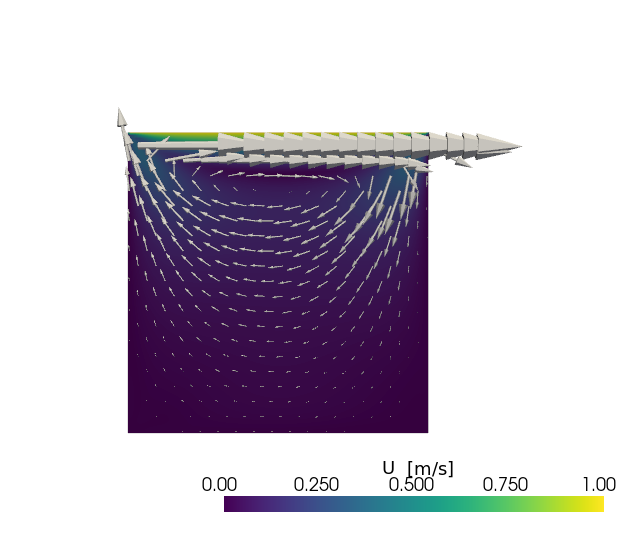
Spatial context first — open the case with
pybFoam.pyvista_read() and render a z-slice through the
cavity slab at endTime with velocity glyphs. This shows where
the vertical mid-line below cuts through the flow.
import pyvista as pv

from pybFoam import pyvista_read

L = 0.1  # cavity edge length
Z_MID = 0.5 * 0.01  # mid-z of the thin cavity slab

reader = pyvista_read(case)
all_times = sorted(t for t in reader.time_values if t > 0.0)

reader.set_active_time_value(all_times[-1])
internal_final = reader.read()["internalMesh"]
internal_final.set_active_vectors("U")
slice_mid = internal_final.slice(normal="z", origin=(0.5 * L, 0.5 * L, Z_MID))

plotter = pv.Plotter(window_size=(640, 540), off_screen=True)
plotter.add_mesh(
    slice_mid,
    scalars="U",
    cmap="viridis",
    show_edges=False,
    scalar_bar_args={"title": "|U|  [m/s]"},
)
plotter.add_mesh(
    slice_mid.glyph(orient="U", scale="U", factor=0.05, tolerance=0.04),
    color="white",
    line_width=1,
)
plotter.view_xy()
plotter.show()
Build an OpenFOAM sampler on the vertical mid-line
We want to sample with OpenFOAM’s own machinery (sampledSet +
interpolation) rather than pyvista, since it gives the same
interpolation OpenFOAM solvers use internally. The line is the
canonical Ghia et al. benchmark cut: vertical at x = L/2 from
floor to lid, 50 evenly-spaced points.
A meshSearch is built once per mesh; the UniformSetConfig +
sampledSet.New factory produces the polyline.
import numpy as np

from pybFoam import Word
from pybFoam.sampling import (
    UniformSetConfig,
    interpolationVector,
    meshSearch,
    sampledSet,
    sampleSetVector,
)

N = 50

search = meshSearch(solver.mesh)
line_cfg = UniformSetConfig(
    axis="distance",
    start=[0.5 * L, 0.0, Z_MID],
    end=[0.5 * L, L, Z_MID],
    nPoints=N,
)
line = sampledSet.New(Word("midLine"), solver.mesh, search, line_cfg.to_foam_dict())

distance = np.asarray(line.distance())
print(f"sample points : {len(distance)}   y range : {distance[0]:.3f} … {distance[-1]:.3f}")
sample points : 50 y range : 0.000 … 0.100
Iterate the written time directories
pybFoam.selectTimes() enumerates every time directory under
the case as a list of instant objects. For each we move the
solver’s Time forward, load U from that time directory
without registering it in the mesh (the still-live solver.U
already occupies that name), and sample the line. The
"cellPoint" interpolation scheme matches the default OpenFOAM
sample utility.
from pybFoam import selectTimes, volVectorField

profiles: list[tuple[float, np.ndarray]] = []

for idx, inst in enumerate(selectTimes(solver.time, ["postProcess"])):
    t = float(str(inst))
    if t == 0.0:
        continue
    solver.time.setTime(inst, idx)
    U_t = volVectorField.read_field(solver.mesh, "U", register=False)
    interp = interpolationVector.New(Word("cellPoint"), U_t)
    sampled = np.asarray(sampleSetVector(line, interp))
    profiles.append((t, np.linalg.norm(sampled, axis=1)))

times = [t for t, _ in profiles]
print(f"sampled {len(profiles)} time steps × {N} points")
sampled 5 time steps × 50 points
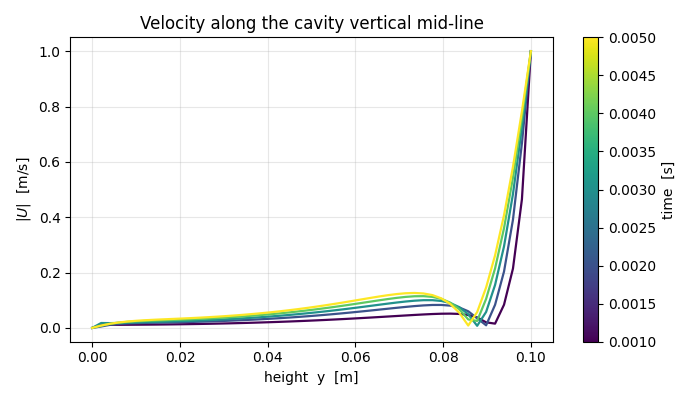
Plot the |U|(y) family
One curve per time step, coloured by physical time. The lid
(y = L) drives the right-hand boundary; momentum diffuses
downward as time progresses, raising the upper portion of every
subsequent curve.
import matplotlib.pyplot as plt

fig, ax = plt.subplots(figsize=(7, 4))

norm = plt.Normalize(vmin=times[0], vmax=times[-1])
cmap = plt.get_cmap("viridis")

for t, u in profiles:
    ax.plot(distance, u, color=cmap(norm(t)), lw=1.6)

ax.set_xlabel("height  y  [m]")
ax.set_ylabel(r"$|U|$  [m/s]")
ax.set_title("Velocity along the cavity vertical mid-line")
ax.grid(alpha=0.3)

sm = plt.cm.ScalarMappable(cmap=cmap, norm=norm)
sm.set_array([])
fig.colorbar(sm, ax=ax, label="time  [s]")
fig.tight_layout()
plt.show()
Total running time of the script: (0 minutes 2.953 seconds)