Note
Go to the end to download the full example code.
Sample a field on a plane
Define a sampling plane with pybFoam.sampling.SampledPlaneConfig,
create the surface through the sampledSurface.New factory, and
interpolate a scalar field onto it. The same pattern works for any
sampledSurface kind — patches, isosurfaces, cutting planes — by
swapping the Pydantic config.
Prerequisite: a sourced OpenFOAM environment.
Set up case + mesh
from pybFoam import Time, argList, clone_example, dictionary, fvMesh
from pybFoam.meshing import generate_blockmesh

case = clone_example("case")
time = Time(argList([str(case), "-case", str(case)]))
generate_blockmesh(time, dictionary.read(str(case / "system" / "blockMeshDict")))
mesh = fvMesh(time)
Seed analytic p_rgh and U
The shipped IC for examples/case/ is uniform zero, which would
leave the sampled plane flat. We seed sinusoidal profiles in place
so the recipe has something to plot.
import numpy as np

from pybFoam import volScalarField, volVectorField, write

p_rgh_seed = volScalarField.read_field(mesh, "p_rgh")
U_seed = volVectorField.read_field(mesh, "U")

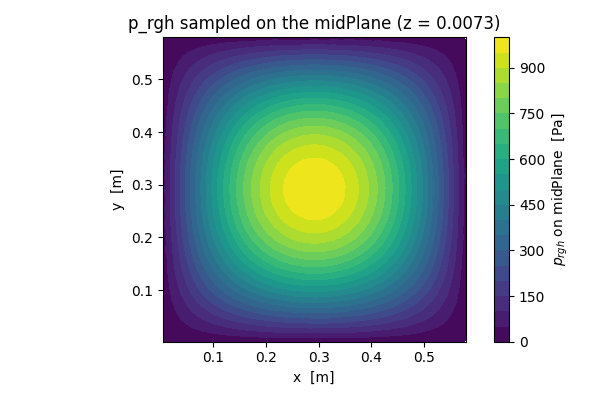
C = np.asarray(mesh.C()["internalField"])
L = 0.584
np.asarray(p_rgh_seed["internalField"])[:] = (
    1000.0 * np.sin(np.pi * C[:, 0] / L) * np.sin(np.pi * C[:, 1] / L)
)
np.asarray(U_seed["internalField"])[:] = np.column_stack(
    [np.sin(np.pi * C[:, 1] / L), -np.sin(np.pi * C[:, 0] / L), np.zeros_like(C[:, 0])]
)
p_rgh_seed.correctBoundaryConditions()
U_seed.correctBoundaryConditions()
write(p_rgh_seed)
write(U_seed)
Define the plane
The Pydantic config validates the fields at construction and converts
to an OpenFOAM dictionary on demand. Here we cut a YZ plane through
x = 0.5 of the dam-break geometry.
from pybFoam import Word
from pybFoam.sampling import SampledPlaneConfig, sampledSurface

cfg = SampledPlaneConfig(point=[0.0, 0.0, 0.0073], normal=[0.0, 0.0, 1.0])
plane = sampledSurface.New(Word("midPlane"), mesh, cfg.to_foam_dict())
plane.update()

print(f"faces: {len(plane.magSf())}   area: {plane.area():.4f}")
faces: 4536 area: 0.3399
Interpolate a scalar field
Pick the interpolation scheme: "cell" (piecewise-constant,
fastest), "cellPoint" (continuous linear, good default), or
"cellPointFace" (most accurate, higher cost).
from pybFoam.sampling import interpolationScalar, sampleOnFacesScalar

p_rgh = p_rgh_seed  # already loaded and seeded above

interp = interpolationScalar.New(Word("cellPoint"), p_rgh)
sampled = sampleOnFacesScalar(plane, interp)

centers = np.asarray(plane.Cf())
values = np.asarray(sampled)
print(f"values.shape  = {values.shape}")
print(f"centers.shape = {centers.shape}")
print(f"p_rgh on midPlane min/max = {values.min():.3f} / {values.max():.3f}")
values.shape  = (4536,)
centers.shape = (4536, 3)
p_rgh on midPlane min/max = 0.734 / 999.261
Sample a vector field on the same surface
from pybFoam.sampling import interpolationVector, sampleOnFacesVector

U = U_seed  # already loaded and seeded above

interp_U = interpolationVector.New(Word("cellPoint"), U)
sampled_U = sampleOnFacesVector(plane, interp_U)
U_values = np.asarray(sampled_U)
print(f"sampled_U.shape = {U_values.shape}")
sampled_U.shape = (4536, 3)
Plot the sampled plane
The plane normal is along z (a horizontal slice through the thin
2-D case), so the in-plane coordinates are (x, y).
tricontourf handles the unstructured face centres without
needing a regular grid.
import matplotlib.pyplot as plt

x, y = centers[:, 0], centers[:, 1]

fig, ax = plt.subplots(figsize=(6, 4))
tcf = ax.tricontourf(x, y, values, levels=20, cmap="viridis")
fig.colorbar(tcf, ax=ax, label=r"$p_{rgh}$ on midPlane  [Pa]")
ax.set_xlabel("x  [m]")
ax.set_ylabel("y  [m]")
ax.set_aspect("equal")
ax.set_title("p_rgh sampled on the midPlane (z = 0.0073)")
fig.tight_layout()
plt.show()
Swap the geometry
The same factory pattern works for any of the surface kinds — patches, isosurfaces, cutting planes, distance surfaces — by swapping the config:
from pybFoam.sampling import SampledPatchConfig

patch_cfg = SampledPatchConfig(patches=["atmosphere"])
patch_surf = sampledSurface.New(Word("atmPatch"), mesh, patch_cfg.to_foam_dict())
patch_surf.update()
print(f"atmosphere patch: {len(patch_surf.magSf())} faces")
atmosphere patch: 46 faces
See also
Sample a field along a line — 1-D version of this recipe.
Sample a field on an isosurface — sample on an iso-surface (e.g. the VOF interface) instead of a plane.
Total running time of the script: (0 minutes 0.204 seconds)